
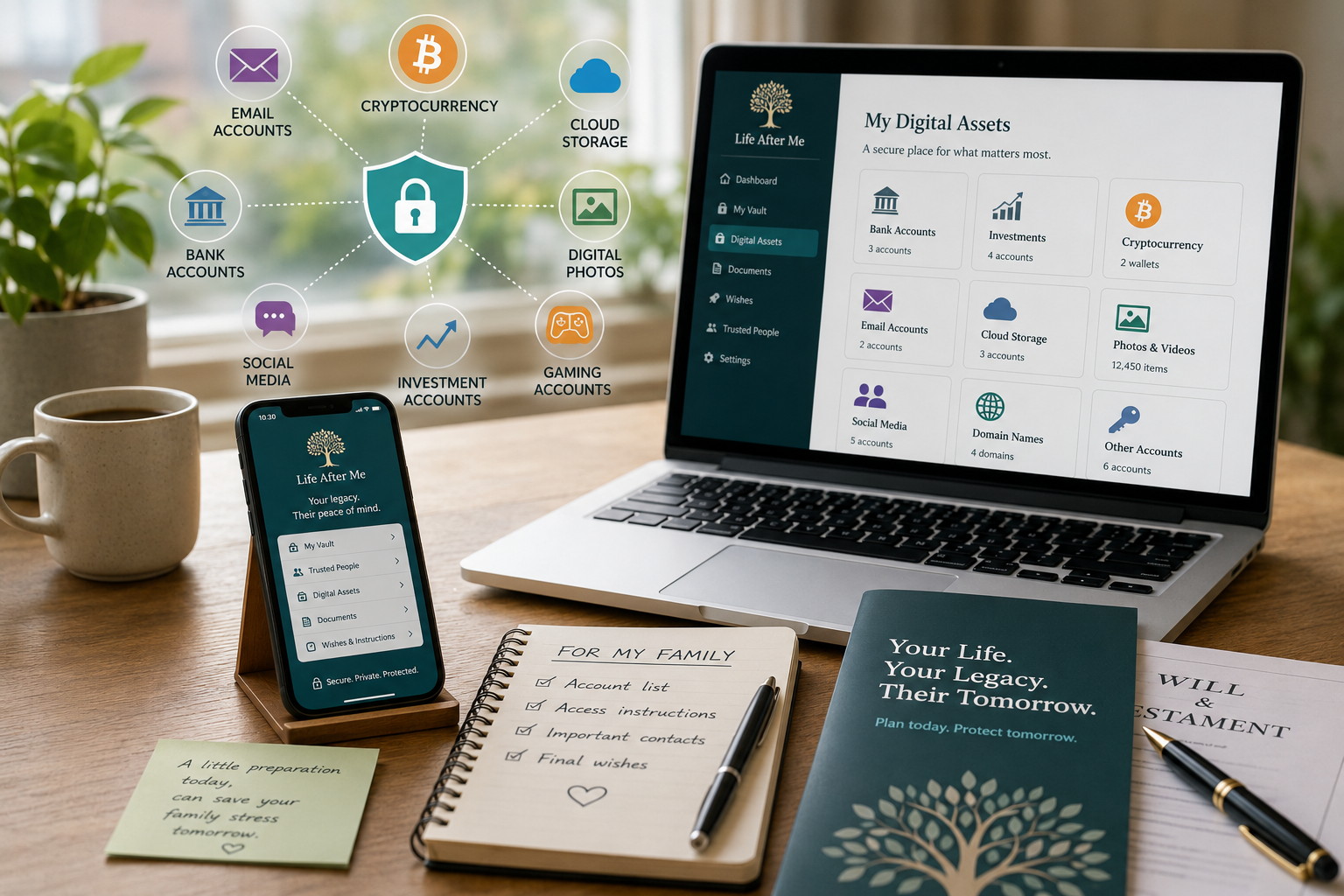
The Digital Assets Your Family May Not Know You Own
Most of us spend years accumulating things that matter: savings, property, investments, perhaps a business. But increasingly, we also accumulate things that exist only online: cryptocurrency, digital photos, email accounts, online investment platforms, gaming accounts, even digital art. When we die, what happens to them?
This is no longer a niche question. A new law and tightening tax rules have changed the picture significantly, and if you have not thought about your digital life as part of your estate, now is a good time to start.
What Counts as a Digital Asset?
The term covers more than most people expect. At one end, there are assets with obvious financial value: cryptocurrency such as Bitcoin or Ethereum, NFTs (digital tokens linked to images or other files), and holdings on online investment platforms. At the other end, there are accounts and records that may have sentimental or practical value but no straightforward cash equivalent: email accounts, social media profiles, digital photo libraries, online subscription services, and domain names.
Saracens Solicitors offer a useful way to think about this, separating digital assets into categories: financial or valuable assets such as cryptocurrencies, NFTs, and exchange accounts; access and control assets such as passwords and seed phrases; owned or registered assets such as domain names and cloud storage; and personal or content assets such as photos, emails, and social media accounts. Not all of them can be inherited, and that distinction matters.
The Law Has Changed
The Property (Digital Assets etc) Act 2025 came into force on 2 December 2025, formally recognising digital assets as personal property under the law of England and Wales. The Law Society describes it as a significant development after years of uncertainty, and it is hard to disagree.
In practical terms, the effect is clear. The Sovereign Group summarise it well: digital assets now form part of a person’s estate and can be gifted, included in residue, held in trust, and valued for tax planning.
Before this Act, there was a legal grey area around whether certain digital assets could be owned and transferred at all. That uncertainty is now largely resolved for assets with genuine financial value. However, there is an important limit to what the law can do. The Society of Will Writers points out that social media accounts cannot usually be inherited, email accounts may not be transferable, and subscription services such as films, music, and digital books are often only licensed to the user rather than owned outright. The Act recognises property rights but cannot override platform terms of service. In other words, your Spotify library is not an asset your family can inherit, regardless of what the law says, because you never owned it.
Do Digital Assets Count for Inheritance Tax?
Yes. HMRC is clear on this: cryptocurrencies and similar assets are treated as property for inheritance tax purposes and form part of the value of the estate, a position Saracens Solicitors confirm has been the case under HMRC guidance for some time, further reinforced by the 2025 Act.
The standard rules apply. The House of Commons Library confirms that inheritance tax is charged at 40% on estates exceeding the £325,000 nil-rate band threshold, frozen at this level since April 2009 and set to remain there until April 2031. If you own your home and leave it to children or grandchildren, an additional residence nil-rate band of £175,000 applies, giving a combined tax-free allowance of up to £500,000 per person, or £1 million for a married couple.
Digital assets are simply added to everything else when calculating the total value of an estate. If someone holds £50,000 in cryptocurrency alongside other assets that push the total above the threshold, that £50,000 is taxable at 40% just like any other asset above the allowance.
One further consideration worth noting: MP Estate Planning highlight that cryptocurrency markets are volatile, meaning the value used for inheritance tax purposes must reflect the fair market value at the time of death. There is no averaging or rounding, and the value on the day is what counts.
The Practical Problem Most Families Face
Knowing the rules is one thing. Actually being able to access and transfer digital assets is another. Cryptocurrency held in a digital wallet can only be accessed using a private key or seed phrase, a unique string of characters that functions like a password. If that is lost, the assets are effectively gone. No bank can recover it. No solicitor can unlock it. No court order will help.
Nottingham Law School’s Rosamund Evans makes the practical challenge clear: personal representatives, the people tasked with administering your estate, have a legal duty to collect and protect all assets, but they need to be able to distinguish between digital assets that carry transferable value and those that are merely licences or service agreements with no inheritable worth. Without clear records left behind, this task becomes extremely difficult.
From January 2026, new OECD Cryptoasset Reporting Framework rules require UK-registered cryptocurrency platforms to collect and report user data to HMRC, which means HMRC will increasingly know about digital asset holdings even if families do not. Tax obligations will follow regardless of whether the assets can actually be located and accessed.
What You Should Do
Three things matter here:
Make a record. List every digital asset you hold that has financial value. Note where it is held, how it is accessed, and what the approximate value is. This record needs to be somewhere your executor can find it, not locked inside the very account it describes.
Update your will. Lexology confirms that digital assets can now be confidently included in wills and estate plans, with executors having a firmer legal basis for collecting, valuing, and distributing them. If your will was written before December 2025, it is worth reviewing whether your digital estate is adequately covered.
Seek professional advice. The interaction between digital assets, inheritance tax planning, and platform terms of service is genuinely complex. A financial adviser or solicitor with experience in estate planning can help ensure your digital wealth is protected and properly accounted for.
This article is for general information only and does not constitute financial or legal advice. The information contained in this article was accurate at the date of publication but may be subject to change. Tax rules can change and their application depends on individual circumstances. If you are unsure how these rules apply to you, please speak to a qualified professional.