
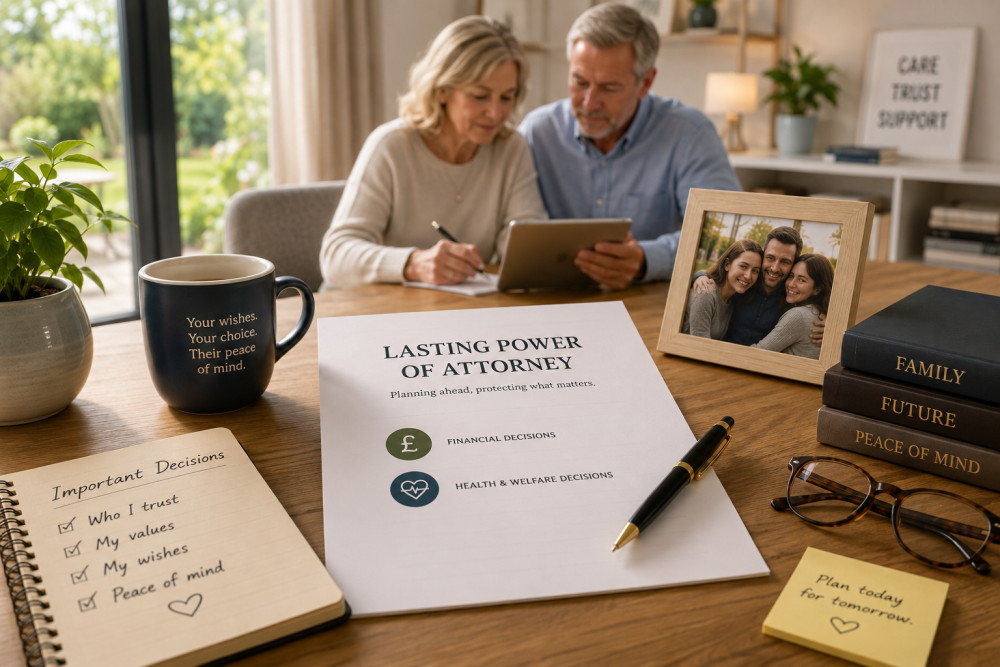
Why a Lasting Power of Attorney Is One of the Most Important Documents You Will Ever Sign
Most people spend considerable time and energy making sure their finances are in order. They write a will, review their pension, perhaps make some investments. But there is one document that many people overlook entirely until it is too late to make it: a Lasting Power of Attorney.
It is not a document about death. It is a document about life, specifically, what happens to your affairs if you are alive but no longer able to manage them yourself.
What Is a Lasting Power of Attorney?
A Lasting Power of Attorney, or LPA, is a legal document that allows you to appoint someone you trust to make decisions on your behalf if you lose the mental capacity to do so yourself. The person making the LPA is called the donor. The person appointed to act is called the attorney.
The BMA sets out the distinction clearly: there are two types of LPA. A property and financial affairs LPA covers decisions about your money, property, bills, and investments. A health and welfare LPA covers decisions about your medical treatment, daily care, where you live, and life-sustaining treatment, but it can only be used once you have lost mental capacity.
Most people need both. They are treated as separate documents.
Who Needs One?
The short answer is: anyone who would want a trusted person to manage their affairs if they could not do so for themselves.
LPAs are often associated with older age or dementia, and those are genuine and important reasons to have one in place. But capacity can be lost at any age, through a stroke, a serious accident, or a sudden illness. Jackson Lees solicitors put it plainly: LPAs are not just for older adults. They are essential for anyone who wants to plan ahead, including younger people who want to make health and financial decisions easier for their families.
Despite this, the gap between need and provision remains significant. Levi Solicitors estimate that only 2.2 million health and welfare LPAs are currently in place, leaving around 13 million people without one. That is a very large number of families who could face serious difficulties if something unexpected happened.
What Happens Without One?
This is where many families get a painful surprise. There is a widespread assumption that a spouse or close family member automatically has the right to manage your affairs if you lose capacity. They do not.
Without an LPA, your family must apply to the Court of Protection for a deputyship order to gain legal authority to act on your behalf. UKLPA.co.uk sets out the financial reality starkly: a deputieship application costs £371 in court fees alone, plus £1,000 to £3,000 or more in solicitor fees, plus ongoing annual supervision charges. By contrast, an LPA costs £92 to register and has no ongoing fees.
The financial difference is significant, but it is not the only issue. As Octopus Legacy explains, deputieship applications typically take several months to complete. During that time, families may be unable to pay bills, access savings, or arrange care, at precisely the moment when they most urgently need to act. The court, not you, also decides who is appointed as deputy, and it may not be the person you would have chosen.
How Do You Make One?
The government's own guidance confirms that you can use the online service to create an LPA, which produces a document you print, get everyone to sign, and then post to the Office of the Public Guardian for registration. The whole process cannot be completed entirely online, as the law currently requires a paper document with handwritten signatures.
The LPA must be signed by you, your chosen attorney or attorneys, and an independent certificate provider, someone who confirms you understand what you are signing and are not being pressured into it.
NBB Waldrons Solicitors note that once submitted, registration currently takes around 8 to 15 weeks. Crucially, an LPA has no legal power until it has been officially registered, so it is wise to register it as soon as it is signed, well before it might be needed.
It is possible to complete the forms yourself, but errors are common and costly. As the estate planning specialists at LANOP highlight, in 2024 the OPG sent back over 133,000 applications. With the registration fee now at £92, errors are more expensive than ever, and if someone loses mental capacity while a rejected form is being corrected, they may no longer be able to sign a new one.
What Is Changing?
The LPA system is undergoing its most significant modernisation in years. Jackson Lees confirms that thanks to the Powers of Attorney Act 2023, the Office of the Public Guardian is developing a fully digital system for creating and registering LPAs, with real-time error checking to reduce delays. A phased rollout is expected, with paper-based applications continuing to run alongside the new system.
A further Powers of Attorney Bill is also making its way through Parliament. Anthony Collins Solicitors report that among its proposals are new duties on banks and care homes to better recognise and support LPAs, expanded investigative powers for the Office of the Public Guardian, and requirements for attorneys to notify the OPG on the death of a donor.
The clear message from legislators is that LPAs matter, and the system needs to work better for the people who rely on it.
Should You Wait for the New System?
No. Jackson Lees are direct on this point: waiting could leave you or a loved one vulnerable. If someone loses mental capacity before an LPA is in place, it is too late to make one. Any LPA made now will still be recognised under the new rules. The current system works, and acting now means your wishes are protected regardless of how the process evolves.
What You Should Do
Talk to the people you trust. Choosing your attorney is the most important decision in this process. It should be someone you trust completely to act in your best interests, not necessarily the most obvious choice.
Make both types of LPA. A financial LPA and a health and welfare LPA cover different situations. TSABI Law set out the comparison clearly: setting up both costs £184 in registration fees, compared to a deputy application that costs £421 upfront, a potential additional £259 if a hearing is required, and then £320 every year in supervision fees thereafter.
Do not delay. Capacity can be lost suddenly and without warning. An LPA can only be made while you still have it. As Willsafe notes, once capacity is lost, the only route is a Court of Protection deputyship application, which is significantly more expensive and more restrictive.
Consider professional advice. A solicitor can help ensure the forms are completed correctly, act as your certificate provider, and make sure your instructions are legally sound. Given the cost and consequences of a rejected application, professional guidance is often well worth it.
This article is for general information only and does not constitute financial or legal advice. The information contained in this article was accurate at the date of publication but may be subject to change. If you are unsure how these rules apply to you, please speak to a qualified professional.