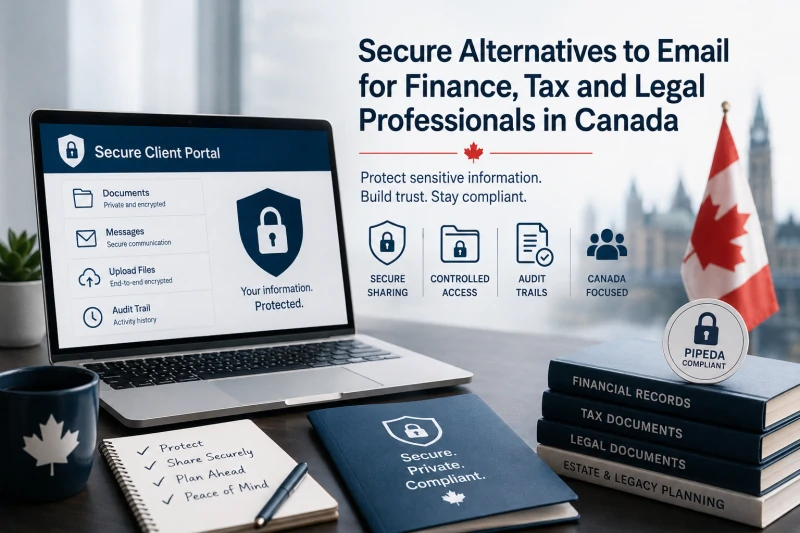
Secure Alternatives to Email for Finance, Tax and Legal Professionals in Canada
While it is widely understood that the standard email is not a secure method of transmitting sensitive information by financial advisors, accountants, and legal professionals, it remains heavily used in practice today. Addressing the gap between regulatory expectations ‘email is insecure’ vs behaviour ‘email is still widely used’ is vital in everyday workflows; that risk exists, innovation is happening and secure portals and platforms exist.
The modern advisor is no longer just a financial or legal expert—they are a custodian of highly sensitive client data, and must adopt secure, compliant, and client-friendly systems for managing and sharing that information.
Professional guidance from the Office of the Privacy Commissioner of Canada under PIPEDA emphasises the importance that personal and financial information must be protected with safeguards appropriate to the information sensitivity. It goes on to identify risks of misuse of data-such as unauthorized access and misdirected communications.
As awareness grows around the limitations of email, financial, tax, and legal professionals in Canada are increasingly adopting more secure methods for sharing sensitive information—aligned with expectations under PIPEDA and guidance from the Office of the Privacy Commissioner of Canada.
“Under PIPEDA, there are categories of information that will generally always be considered sensitive (and therefore require a higher degree of protection). These include health and financial data, ethnic and racial origins, political opinions, genetic and biometric data, an individual’s sex life or sexual orientation, and religious or philosophical beliefs.” Co-authored by Laure Bonnave and Nathalie David, Partners of Clyde & Co -a global law firm that navigates risk
Canada-Appropriate Ways to Send Sensitive Information
- Secure Client Portals
Widely used by accounting firms, financial advisors, and legal practices, secure portals allow clients to upload and access documents through encrypted, login-based systems. These platforms provide controlled access, audit trails, and significantly reduce the risk of unauthorized disclosure. - Encrypted File Sharing
Tools such as Google Drive, Dropbox, and Microsoft OneDrive are commonly used when configured properly—restricting access, setting permissions, and limiting link sharing. When paired with password protection, these tools offer a meaningful step up from standard email. - Password-Protected Documents
A practical interim solution, particularly for individuals, involves securing documents using tools like Adobe Acrobat or Microsoft Word, and sharing passwords through a separate channel. While not foolproof, this method adds an important layer of protection. - Secure E-Signature Platforms
Platforms such as DocuSign and Adobe Acrobat Sign enable secure document delivery, signing, and storage within encrypted environments, and are now widely accepted across financial and legal industries.
To provide additional clarity on safeguarding client data and maintaining privacy within the Canadian landscape, several prominent professional associations have established specific recommendations and regulatory guidelines: for accountants CPA Canada, legal Canadian Bar Association and financial Canadian Investment Regulatory Organization.
Interesting to note are the additional lengths to reinforce security by the Canadian Investment Regulatory Organization (CIRO); that requires firms to implement controls around client data handling and hold advisors accountable for how information is shared and stored. In addition, Financial advisors must disclose to their clients if their client’s data is stored outside of Canada, e.g. US servers.
Despite guidance provided to professionals, information obtained through industry observations and professional commentary indicates that email remains one of the most commonly used tools for document exchange, mostly due to convenience, habit and client expectations, rather than security. The development of platforms like Life After Me is specifically developed to mitigate these pervasive systemic challenges.
Evolving Regulatory Landscape 2026
A brief overview from Lerners Law—a firm providing comprehensive support in areas such as breach response, regulatory reporting, and impact assessments—outlines the following critical privacy considerations for 2026:
- Canadian Privacy Act Review: Consultations regarding modernizing the Privacy Act to recognize privacy as a fundamental right are ongoing, with final reports expected in 2026–2027, aiming for stronger enforcement and breach notification requirements.
- Breach Reporting: Mandatory breach notifications are now firmly in place, requiring organizations to report incidents that create a "real risk of significant harm" to individuals.
- AI Compliance: New regulations in 2026 focus on AI-driven data analysis, forcing firms to conduct Privacy Impact Assessments (PIAs) when using automated tools for financial advice or document processing.
Consumer Considerations
From a consumer standpoint, there is a frequent tendency to overlook the significant vulnerabilities involved when transmitting confidential files via standard email platforms.
Read on how Life After Me addresses these critical needs by providing an all-in-one document storage solution and digital legacy planning tool.
Canada-Specific Reality Check
As a consumer, you are not regulated on secure document sharing practices like a business, but your information is still protected under PIPEDA, making a secure transmission essential. The professionals receiving your info, will potentially offer secure upload portals and have a preference for encrypted or password-protected files, if none is offered it’s completely reasonable for you to ask.
Prior to transmitting any confidential data, perform a quick evaluation by considering the following:
"What would be the most severe outcome if this email were to be intercepted or mistakenly shared?"
If the answer is “identity theft” or “financial risk,” use a secure method.
Here is a simple guideline on what to avoid sending by plain email format:
- SIN numbers
- banking info
- full legal documents
- reusing the same password for multiple documents
- sending password and document in the same email thread.
Following these guidelines will provide stronger safeguards and better align with Canadian privacy expectations.
A Smarter, Long-Term Approach
Although existing security measures offer improved protection, they still necessitate frequent document transfers, underscoring the demand for a more integrated, enduring strategy. How to address common frustrations such as the constant search for lost records or the inefficiency of providing the same information repeatedly?
This disconnect between what privacy standards professionals are asked to adhere to and what is practiced in day-to-day client interactions is driving a stronger shift toward a secure, centralized document management and sharing solutions system, including platforms like Life After Me which aim to reduce friction while improving both security and client experience.
Platforms like this allow you to:
- Store important documents in one safe and secure location
- Ability to access sensitive information anytime
- Share access with trusted professionals or family when needed
- Avoid the risks of repeatedly emailing sensitive information
- Ensure everything is organized for future planning, including estate and legacy needs
This style of document storage and sharing platform ensures that both individuals and professionals are working together to protect sensitive and private information and making it easier to share when needed.
Research from Deloitte indicates that as client expectations evolve, financial, legal, and tax professionals must deliver secure, digital-first experiences to remain competitive.
Security is now part of the client experience, not just compliance.
Life After Me acts as a secure digital solution for storing final wishes, memories, and important documents like legal records and financial accounts. Designed specifically for Canadians, the platform ensures data is stored safely within Canada and adheres to privacy-conscious standards like PIPEDA.
The platform simplifies legacy planning through a five-step process:
- Step 1: Sign up at lifeafterme.ca to create a secure account.
- Step 2: Add key contacts who will need access to your wishes and information when the time comes.
- Step 3: Upload essential documents such as your will, insurance policies, and financial records into neatly organized folders.
- Step 4: Personalize your legacy by adding funeral preferences, heartfelt messages, and digital asset instructions.
- Step 5: Customize notifications to determine who is alerted and how your legacy is handled.
By using Life After Me, users can designate "Trusted Appointees"—loved ones who receive access to specific information—and "Expert Advisers," such as financial planners, tax planners or legal counsel, who can help manage and upload documents. This proactive approach replaces traditional, insecure email exchanges with a centralized, encrypted vault, providing peace of mind for both individuals and their families.
While no single solution fits every situation, the shift is clear: secure, access-controlled, and auditable methods stored in one central location are replacing traditional email as the standard for handling sensitive information.
Begin your Life After Me trial for free.
Article Sources
https://www.pv.gc.ca/en/
https://www.priv.gc.ca/en/privacy-topics/privacy-laws-in-canada/the-personal-information-protection-and-electronic-documents-act-pipeda/
https://www.cpacanada.ca/my-cpa-canada/join
https://www.cba.org/home/
https://www.ciro.ca/
https://www.clydeco.com/en/insights/2022/06/opc-provides-clarity-on-the-interpretation-of-sens?utm_source=chatgpt.com
https://www.deloitte.com/ca/en/Industries/financial-services/perspectives/future-canada-insurance.html?utm_source=chatgpt.com
https://lerners.ca/practices/privacy-and-cybersecurity